


The Canadian Atlas of Palliative Care
The Alberta Atlas of Palliative Care
Discover how palliative care is delivered and accessed across Alberta with the new Canadian Atlas of Palliative Care: Alberta Edition — the first resource of its kind in the province.


Mapping palliative care across Alberta
The need for timely, equitable, and compassionate palliative care in Alberta has never been greater. As more people live longer with serious and life-limiting illnesses, understanding where services exist and where gaps remain is essential to improving care for all Albertans.
Bringing Alberta’s palliative care system into focus
The Canadian Atlas of Palliative Care: Alberta Edition provides the first comprehensive, data-driven overview of how palliative care is delivered and accessed across the province. Developed by Pallium Canada and the Division of Palliative Medicine at the University of Calgary, with support from the Division of Palliative Care at McMaster University, this first-of-its-kind provincial resource brings together data from both provincial and regional levels across key domains such as policy, services, and education. It highlights Alberta’s many strengths while identifying areas where focused action can improve access and coordination of care.
Available as an interactive online story map and a complementary PDF report, the Alberta Atlas is designed to inform health system planning, guide policy, and inspire collaboration toward a more coordinated and equitable palliative care system for every Albertan.
Dive deeper into the Alberta Edition of the Canadian Atlas of Palliative Care
Dive into the key findings from the Alberta Edition of the Canadian Atlas of Palliative Care! In this webinar, Pallium Canada’s CEO Jeffrey Moat and Dr. Leonie Herx walk through the key findings, strengths and opportunities to improve palliative care access in Alberta.
Partnerships and acknowledgments
The Alberta Edition of the Canadian Atlas of Palliative Care was developed by Pallium Canada and the Division of Palliative Medicine at the University of Calgary, with support from the Division of Palliative Care at McMaster University.
Collaboration from key provincial stakeholders, including Covenant, Alberta Health Services and the Alberta Hospice and Palliative Care Association, helped ensure the Atlas reflects the realities of palliative care across the province. Funding for this project was provided by the Government of Alberta.




About the Canadian Atlas of Palliative Care: Alberta Edition
The Alberta Edition of the Canadian Atlas of Palliative Care goes beyond data to bring visibility to the realities faced by patients, families, and health care providers across Alberta. Developed with insights from regional palliative care leaders, front-line health care professionals, policymakers, educators, researchers, and community advocates, the Atlas reflects the lived realities of care delivery across the province.
With the Alberta Atlas, users can:


Explore palliative care by Alberta Health Zones, allowing users to view availability, identify disparities, and understand regional variations in service delivery.
Compare key aspects of palliative care across different domains, from specialist services to primary and generalist-level integration in primary care, long-term care, and other health care settings.
Identify gaps and opportunities for improvement across services, education, policies, resources and focused populations.
Enhance transparency and accountability in the health care system and informed decision-making among policymakers, health care leaders, and the public.
Key findings
The following highlights the key findings and insights derived from the Atlas, which reveal that while the province has built a strong foundation for palliative care, regional and population-based inequities persist.
There is a strong foundation of frameworks and policies to guide palliative care
Alberta has robust provincial frameworks, policies, standards and guidelines — such as the Alberta Interprofessional Palliative Care Competency Framework (2023), the Continuing Care Act (2024), the Care of the Imminently Dying Pathway instructions, and the Expected Death in the Home guidelines — to guide palliative care delivery. The province also provides the Palliative Coverage Program for medications and ambulance services, and the Government of Alberta, notably, has invested $20 million over the past five years to strengthen palliative care.
Hospitals provide high levels of access to specialty palliative care teams
Across the province, hospitals offer high levels of access to specialist palliative care consult teams with in person consultation available in most medium to large urban centres, visiting consultants in some rural hospitals, and 24/7 virtual specialist palliative care advice available province-wide through the RAAPID service. The integration of palliative care across various hospital inpatient and outpatient services is partially high for cancer care, supported by a dedicated provincial strategy from Cancer Care Alberta, but is partially low for non-cancer services.
There is a shortage of palliative care unit beds and hospice beds
The total number of palliative care unit (PCU) and hospice beds falls short of provincial needs, reaching 83% of the target. This leaves patients with complex palliative care needs without timely access to dedicated inpatient care. These gaps are most pronounced in the predominantly rural North (67%) and South (64%) Zones, compared with the higher coverage in the Edmonton (85.5%), Central (84%), and Calgary (81.5%) Zones. Acute palliative care bed capacity is especially limited. The South Zone has no PCU beds, the Calgary and Edmonton Zones have less than half of the number of beds required, and most beds in the North Zone are functioning primarily as hospice beds.
Access to palliative care in the community is well established
Alberta has good access to palliative care consult teams, coordinated services across care settings, and ongoing efforts to build primary palliative care capacity. After-hours support is often available in-person in the major urban centres and virtually in smaller and rural communities through the provincial RAAPID system. The province also provides 24/7 support for emergent symptom needs through the EMS PEOLOC program. Dedicated palliative home care services with after-hours nursing supports are available in some large urban areas, while smaller and rural areas rely on general home care teams with more limited after-hours support.
Equitable access to palliative care remains a significant challenge
Rural and remote communities often rely on virtual support, and the province has only one pediatric hospice, located in Calgary. Underserved populations—including 2SLGBTQI+ persons, people experiencing homelessness, incarcerated persons, refugees, and immigrants—face inconsistent care due to the lack of coordinated strategies. Emerging models show promise and could be scaled for broader impact across populations and regions.
The provision of primary palliative care is limited
Many family physicians and primary care teams support patients in clinic settings, but few provide home visits or provide after-hours on-call support, leaving major gaps for patients with advanced illnesses. Some Primary Care Networks offer evening coverage through walk-in clinics, but patients must travel and be seen in person. Expanding home-based palliative care by primary care teams would improve continuity and access.
Go beyond the key findings
The interactive Alberta Edition of the Canadian Atlas of Palliative Care provides a detailed look at palliative care across the province. Explore regional data, compare service availability across domains, and uncover insights to drive meaningful change.

Behind every data point in the Alberta Atlas is a person or family facing life-limiting illness. The Atlas reminds us why this work is so critical. It helps us see where we can make care more equitable, more compassionate, and more accessible in Alberta. This is a powerful step toward building a more coordinated and equitable palliative care system for all Albertans.

Jeff Moat
CEO, Pallium Canada
The Alberta Atlas reflects what is possible when researchers, partners, and health care providers come together with a shared vision. This collaboration has created a powerful resource that not only maps out where we are today, but also helps to guide us toward a more equitable and compassionate future for palliative care in Alberta.

Dr. Leonie Herx
Project Co-lead and Co-Principal Investigator; Division of Palliative Medicine, University of Calgary; Pallium Canada, Canada
The Alberta Atlas builds on our growing national understanding of the state of palliative care in Canada. Alberta’s results show important progress in building a strong foundation for palliative care, but they also reveal inequities that persist across regions and populations. By comparing findings across provinces, we can better understand system strengths and drive action to improve access to quality care across Canada.

Dr. José Pereira
Project Co-lead and Co-Principal Investigator; Department of Family Medicine, McMaster University, Canada; Institute for Culture and Society, University of Navarra, Spain; Pallium Canada, Canada
The Atlas is about more than data. It’s about dignity. Palliative care is not just health care. It is a way of caring that honours life, eases suffering and respects each person’s story, values and needs. The Atlas gives us insight we can act on and aligns with our vision to make palliative care accessible, timely and fair for everyone in Alberta.

Patrick Dumelie
President and CEO, Covenant
Commonly asked questions
What is a palliative care atlas?
A palliative care atlas is a resource that provides a visual and text-based overview of the status of palliative care across several domains, within a specific region or country. They highlight strengths and excellence, identify gaps, and inform health care planning with the goal of improving palliative care systems.
How does this Atlas support improvements in palliative care?
By mapping the availability and accessibility of palliative care services across Alberta, the Atlas helps identify areas where resources are needed most. It serves as a tool for advocacy, informing policy development, and guiding health care planning to strengthen palliative care services in the province.
Why doesn’t this edition of the Atlas include palliative care for Indigenous populations?
This edition of the Canadian Atlas of Palliative Care does not seek to reflect palliative care services and programs of First Nations, Inuit, or Métis peoples in Canada. Instead, with humility and in the spirit of reconciliation, Pallium Canada is dedicated to collaborating in a distinct process, led and developed by Indigenous Peoples, to describe palliative care across Turtle Island provided by, with and for Indigenous peoples. Such mapping will adhere to the First Nations Principles of Ownership, Control, Access, and Possession (OCAP®), Manitoba Métis principles of OCAS (Ownership, Control, Access and Stewardship), and Inuit Qaujimajatuqangit.
What health zones are covered in this Atlas?
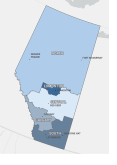
The Alberta Edition of the Canadian Atlas of Palliative Care covers five Alberta Health Services Zones: North, Edmonton, Central, Calgary and South.
Will this edition of the Atlas be updated?
Yes, like other palliative care atlases, the Alberta Atlas is intended to be updated every five years. Regular updates will help track changes, improvements, and emerging needs in palliative care services across the province.
How can the Atlas be used?
The Alberta Edition of the Canadian Atlas of Palliative Care serves as a valuable tool for policymakers, health care providers, researchers, and communities to assess the state of palliative care in the province. It helps identify successes, gaps, and opportunities for improvement, guiding decision-making and future planning to improve palliative care accessibility and quality.
What data does this Atlas include?
The Alberta Edition of the Canadian Atlas of Palliative Care provides a cross-sectional view of palliative care services across the province. It examines health care services, policies, system performance, education, community engagement, and professional activities. Some indicators, such as the presence of a palliative care unit or policy, are reported as “Yes,” “No,” or “Partial,” while others, including palliative care integration levels, are assessed based on expert judgment. Where possible, the Atlas applies established benchmarks, such as the recommended number of palliative care beds per population, to evaluate adequacy.
Where does the data for this Atlas come from?
The Alberta Edition of the Canadian Atlas of Palliative Care uses a mixed-methods approach, combining surveys, interviews, and focus groups with health care professionals, policymakers, and regional palliative care leaders. Where available, publicly accessible data sources were also used. Expert input and consensus reviews helped validate findings to ensure accuracy. While some data gaps exist due to resource limitations or availability, multiple perspectives were incorporated to provide the most comprehensive overview possible.
How were the findings of this Atlas validated?
The data in this Atlas was validated through objective measures (e.g., presence of policies or services), expert judgment for harder-to-measure indicators, and established standards like the Catalonia Formula for palliative care beds. Multiple stakeholder reviews helped ensure accuracy and reduce bias.
Who contributed to the development of this Atlas?
The Alberta Edition of the Canadian Atlas of Palliative Care was informed by the insights and expertise of front-line health care professionals, managers, directors, policymakers, educators, researchers and advocates from across the province. Their insights and expertise ensured that the Atlas reflects the realities of palliative care delivery in Alberta. Key provincial stakeholders, including Alberta Health Services, Covenant Health and the Alberta Hospice and Palliative Care Association, played a central role in shaping the content by sharing their knowledge and expertise. Together, these contributors provided a comprehensive overview of the current state of palliative care in their respective regions.
Mapping the future of palliative care in Canada
The Alberta edition of the Canadian Atlas of Palliative Care is part of a national effort to map access to palliative care across Canada.
Data alone doesn’t drive change; people do. The Atlas is a vital tool for policymakers, health care leaders and communities to push for better access, stronger collaboration, and a future where high-quality palliative care is available to all.





 Back
Back